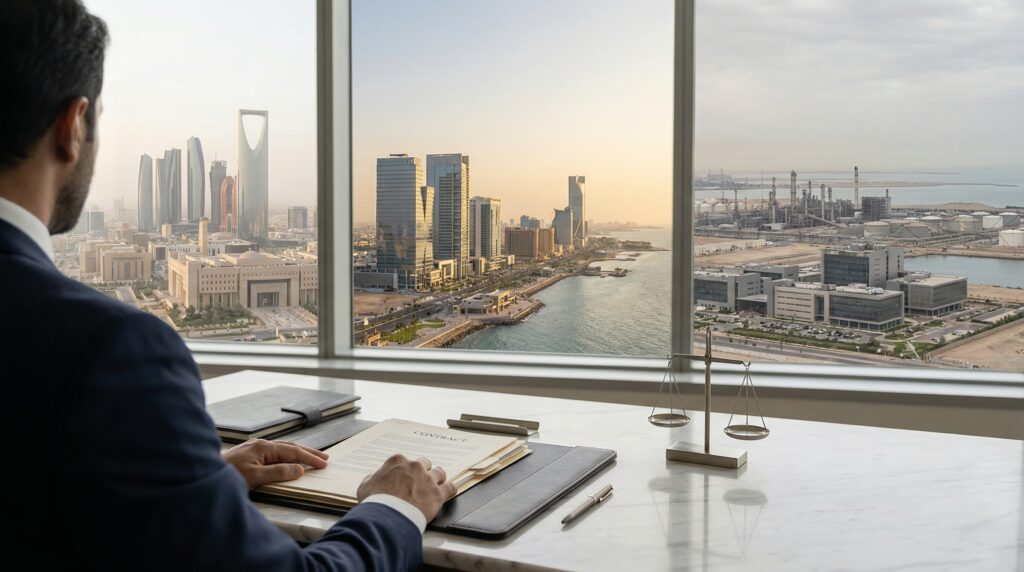
The best province in Saudi Arabia for foreign business depends on sector, licensing classification, and regulatory exposure under the Foreign Investment Law administered by the Ministry of Investment (MISA).
Riyadh Province offers the strongest regulatory access and government contracting environment; Makkah Province provides trade and logistics advantages through Jeddah; Eastern Province supports energy, industrial, and petrochemical investments. Under Saudi Arabia’s Foreign Investment Law and implementing regulations issued by MISA, foreign investors must obtain an investment license before commercial registration. Province selection affects tax exposure, industrial incentives, workforce compliance, and dispute resolution access.
TL;DR
- Saudi Arabia permits foreign investors to establish companies in any province under the Foreign Investment Law administered by the Ministry of Investment (MISA).
- Province selection affects regulatory interaction, sector approvals, logistics infrastructure, and industrial incentives, but does not change federal corporate income tax rates.
- Riyadh Province supports government contracting and regulatory access; Makkah Province (Jeddah) supports trade and logistics; Eastern Province supports energy and industrial sectors.
- Foreign investors must obtain a MISA investment license, complete commercial registration with the Ministry of Commerce, and register with tax and social insurance authorities before commencing operations.
- Commercial disputes are resolved through Saudi commercial courts or arbitration under the Saudi Arbitration Law, depending on contractual dispute-resolution clauses.
Table of Contents
Does Saudi Law Restrict Foreign Investors to Certain Provinces?
Saudi Arabia does not legally restrict foreign investors to a specific province under the Foreign Investment Law. The Ministry of Investment (MISA) issues licenses that permit activity across Saudi Arabia, subject to sector-specific restrictions. The primary legal limitation relates to restricted or excluded sectors, not geographic territory. Investors must consult the official negative list issued by MISA and comply with the Companies Law administered by the Ministry of Commerce. Official reference: Ministry of Investment (MISA)
Legal requirement under Saudi law:
- Obtain a foreign investment license from MISA.
- Register a commercial entity with the Ministry of Commerce.
- Comply with Zakat, Tax and Customs Authority registration.
- Register with the General Organization for Social Insurance (GOSI).
Regulatory practice by Saudi authorities:
- Some industrial incentives are geographically linked to economic cities.
- Regional headquarters programs prioritize Riyadh.
Strategic legal consideration:
- Province selection affects regulatory interaction frequency, especially for regulated sectors such as financial services, education, and healthcare.
Why Is Riyadh Province Often Considered the Primary Business Hub?
Riyadh Province functions as the administrative capital of Saudi Arabia and hosts central regulatory bodies, including the Ministry of Investment (MISA), Ministry of Commerce, and key supervisory authorities. Foreign investors targeting government contracts, fintech, consulting, or regulated services benefit from proximity to regulatory decision-makers. Riyadh also aligns with the Regional Headquarters (RHQ) program requirements introduced under Saudi economic reforms.
Legal requirements:
- Foreign companies establishing regional headquarters must meet substance criteria defined by MISA.
- Government contracting eligibility increasingly requires a regional headquarters presence in Riyadh.
Regulatory practice:
- Licensing approvals are often processed faster when corporate representation exists in Riyadh.
- Government tenders favor companies with local executive presence.
Strategic consideration:
- Riyadh provides stronger dispute resolution accessibility through commercial courts and arbitration centers.
For structured market entry planning, review the detailed framework in Foreign Investment in Saudi Arabia.
Is Makkah Province (Jeddah) Better for Trade and International Business?
Makkah Province, particularly Jeddah, operates as the primary commercial gateway of Saudi Arabia through King Abdulaziz Port and international logistics infrastructure. Foreign investors engaged in import-export, distribution, hospitality, retail, and Umrah-related services often select Jeddah for operational efficiency.
Legal requirement:
- Commercial agencies and distribution arrangements must comply with Saudi Commercial Agencies Regulations.
- Customs compliance must follow Zakat, Tax and Customs Authority procedures.
Regulatory practice:
- Trade licensing approvals may involve municipal authority engagement.
- Port-related businesses require additional clearances from transport authorities.
Strategic consideration:
- Logistics-based companies benefit from reduced inland transport costs compared to Riyadh.
Investors planning cross-border distribution structures should integrate regulatory mapping under Legal Strategy for Foreign Business in Saudi Arabia.
Does Eastern Province Offer Stronger Opportunities for Industrial and Energy Investors?
Eastern Province, including Dammam, Dhahran, and Jubail, is central to energy, petrochemical, and heavy industrial investment in Saudi Arabia. Proximity to oil and gas infrastructure creates sector-specific opportunity, particularly for engineering, manufacturing, and industrial services companies.
Legal requirement:
- Industrial licensing may require additional approval from the Ministry of Industry and Mineral Resources.
- Environmental compliance must align with national environmental regulations.
Regulatory practice:
- Industrial land allocation often occurs through industrial cities managed by government entities.
- Certain incentives are linked to industrial cluster programs.
Strategic consideration:
- Arbitration clauses are strongly recommended in energy-related contracts due to technical dispute complexity.
- Investors must evaluate dispute resolution mechanisms carefully under Arbitration vs Litigation in Saudi Arabia.
How Do Special Economic Zones Influence Province Selection?
Saudi Arabia has introduced Special Economic Zones (SEZs) offering tax incentives, customs exemptions, and regulatory facilitation.
Legal requirement:
- SEZ investors must comply with zone-specific regulations in addition to national law.
- MISA licensing remains mandatory.
Regulatory practice:
- Incentives vary depending on sector classification.
- Employment quotas may differ within economic zones.
Strategic consideration:
- Long-term stability of incentives should be contractually documented.
- Exit and repatriation clauses must be clearly drafted.
For dispute mitigation planning, review Ways to Avoid Business Disputes in Saudi Arabia.
How Does Taxation Affect Province Choice in Saudi Arabia?
Saudi Arabia applies federal taxation, meaning corporate income tax rates do not vary by province. However, operational costs differ significantly.
Legal requirement:
- Foreign-owned entities are subject to 20% corporate income tax.
- Zakat applies to Saudi/GCC shareholders.
Regulatory practice:
- Municipal fees differ by city.
- Industrial utilities pricing varies regionally.
Strategic consideration:
- Cost modeling must include lease rates, labor availability, and transport logistics.
What Role Do Saudi Courts and the Saudi Arbitration Law Play in Province Selection?
Dispute resolution access affects risk exposure for foreign investors. Saudi courts have jurisdiction nationwide, but commercial court efficiency may vary by region. The Saudi Arbitration Law permits parties to agree on arbitration as an alternative dispute mechanism.
Legal requirement:
- Arbitration agreements must be in writing.
- Awards are enforceable through Saudi courts.
Regulatory practice:
- Enforcement timelines vary by court workload.
Strategic consideration:
- Riyadh and Eastern Province often provide more developed commercial dispute infrastructure.
Understanding procedural risk exposure requires consultation with Importance of Having a Local Counsel in Saudi Arabia.
Which Province Is Strategically Optimal for Specific Sectors?
Technology and consulting: Riyadh Province due to regulatory proximity.
Logistics and distribution: Makkah Province (Jeddah).
Energy and industrial services: Eastern Province.
Tourism and hospitality: Makkah Province and emerging development zones.
Government contracting: Riyadh Province.
Sector alignment must always be evaluated against licensing classification under MISA regulations.
What Licensing Steps Apply Regardless of Province?
- Submit foreign investment application to the Ministry of Investment (MISA).
- Obtain MISA investment license.
- Register Articles of Association with Ministry of Commerce.
- Issue Commercial Registration (CR).
- Register with Zakat, Tax and Customs Authority.
- Register with General Organization for Social Insurance.
- Open Saudi bank account.
- Obtain municipal and sector-specific permits.
Failure to complete sequential registration may invalidate commercial activity.
Legal Takeaways for Foreign Investors
- Saudi Arabia does not legally restrict foreign investors to a specific province.
- Province selection influences regulatory access, logistics costs, and dispute exposure.
- MISA licensing is mandatory regardless of geographic location.
- Industrial and energy sectors align strongly with Eastern Province.
- Government-related activity aligns strongly with Riyadh Province.
Engaging qualified Saudi legal counsel ensures regulatory compliance and mitigates enforcement risk before capital deployment.
Frequently Asked Questions
Can a foreign investor open a company anywhere in Saudi Arabia?
Yes. The Foreign Investment Law permits establishment in any province subject to licensing approval from the Ministry of Investment (MISA).
Is Riyadh mandatory for foreign companies?
Riyadh is not mandatory unless the company seeks eligibility under the Regional Headquarters program for government contracts.
Which province has the lowest tax in Saudi Arabia?
Corporate income tax is federally applied and does not vary by province.
Does Eastern Province require additional approvals?
Industrial projects may require approvals from the Ministry of Industry and Mineral Resources.
Are Special Economic Zones legally separate from Saudi law?
Special Economic Zones operate under national law with additional regulatory frameworks and incentives.
Avoid Costly Legal Mistakes
Free 30-minute consultation with a Saudi investment lawyer. Get answers before you invest.
Schedule Free Consultation